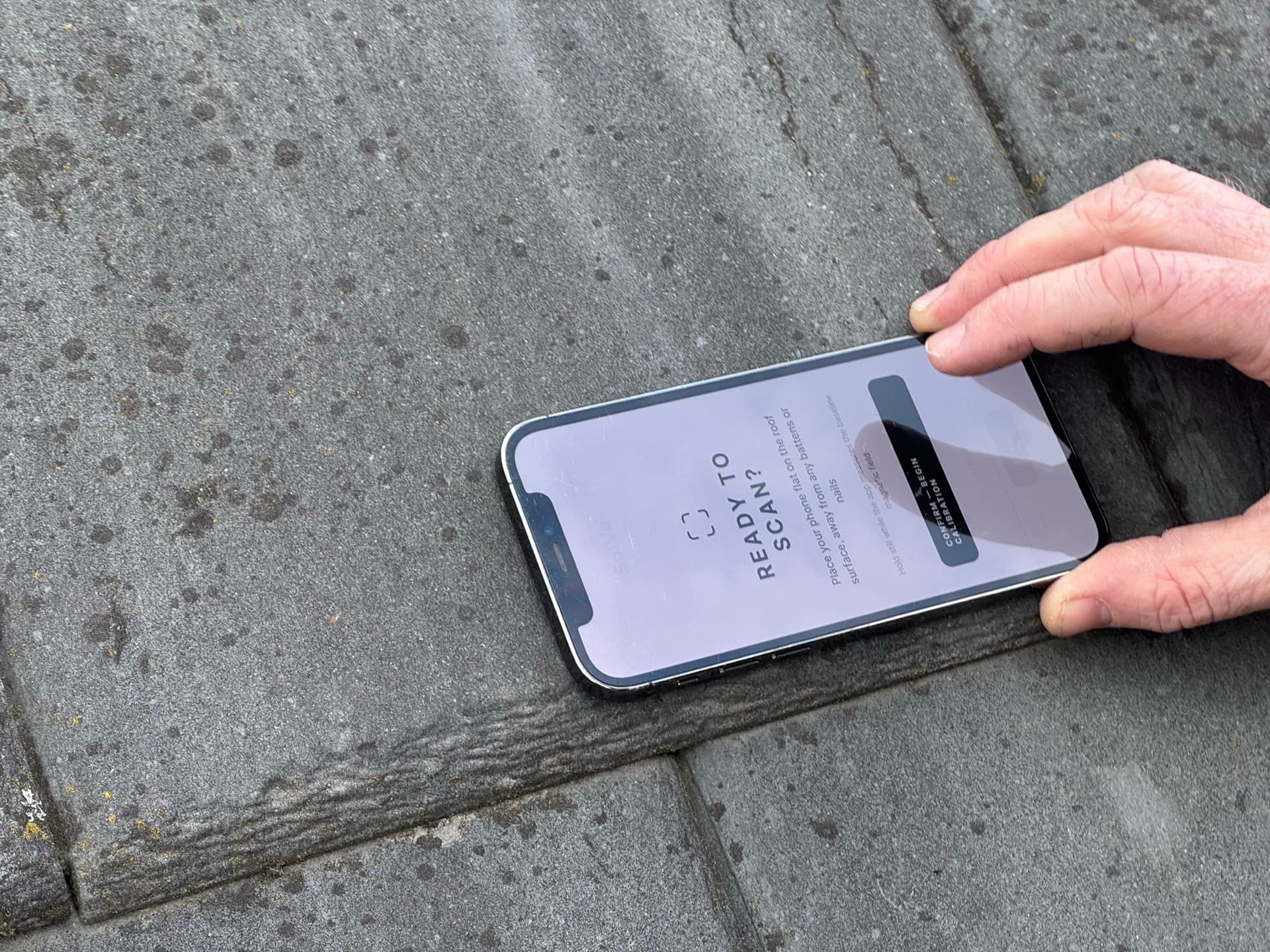
The main factor isn’t only “slate vs tile” — it’s the distance from the sensor to the rafter nail. Thickness, profile, and multi-layer systems all change the job.
Thin coverings — free direct scan
- Natural slate (typical thin)
- Cambrian and similar thin interlocking products
- Many fibre-cement and thin single-lap coverings
Here the free app is strong. Place the phone, run device calibration (so the app knows where your sensor is), scan, confirm.
Thicker coverings — free app + magnets
- Heavy natural slate
- Plain clay or concrete tiles
- Interlocking concrete tiles
- Many double-lap systems
Place three spaced neodymium magnets along each rafter so the free app can lock on. That keeps free useful without putting every crew on hardware.
Every covering — Pro & Sled
Pro is for every roof covering — including stone, very thick stacks, and multi-layer systems that sit beyond free range. You get a dedicated sensor and wheeled sled, 150× better resolution* than phone-only sensing, deeper nail detection, simpler calibration, and AR rafter overlay — planned at £329 a year with hardware included. Free stays the right tool for thin coverings like slate; Pro covers every covering. (*Targeting 166× better resolution — currently in development.)
Free vs Pro in practice
Rule of thumb: free phone sensing is strong on thin coverings like slate. Beyond that, plan magnets for some free jobs — or Pro for every roof covering. Always check the in-app guide on the roof.
See the full coverage matrix and pick Free or Pro for the roofs you work.