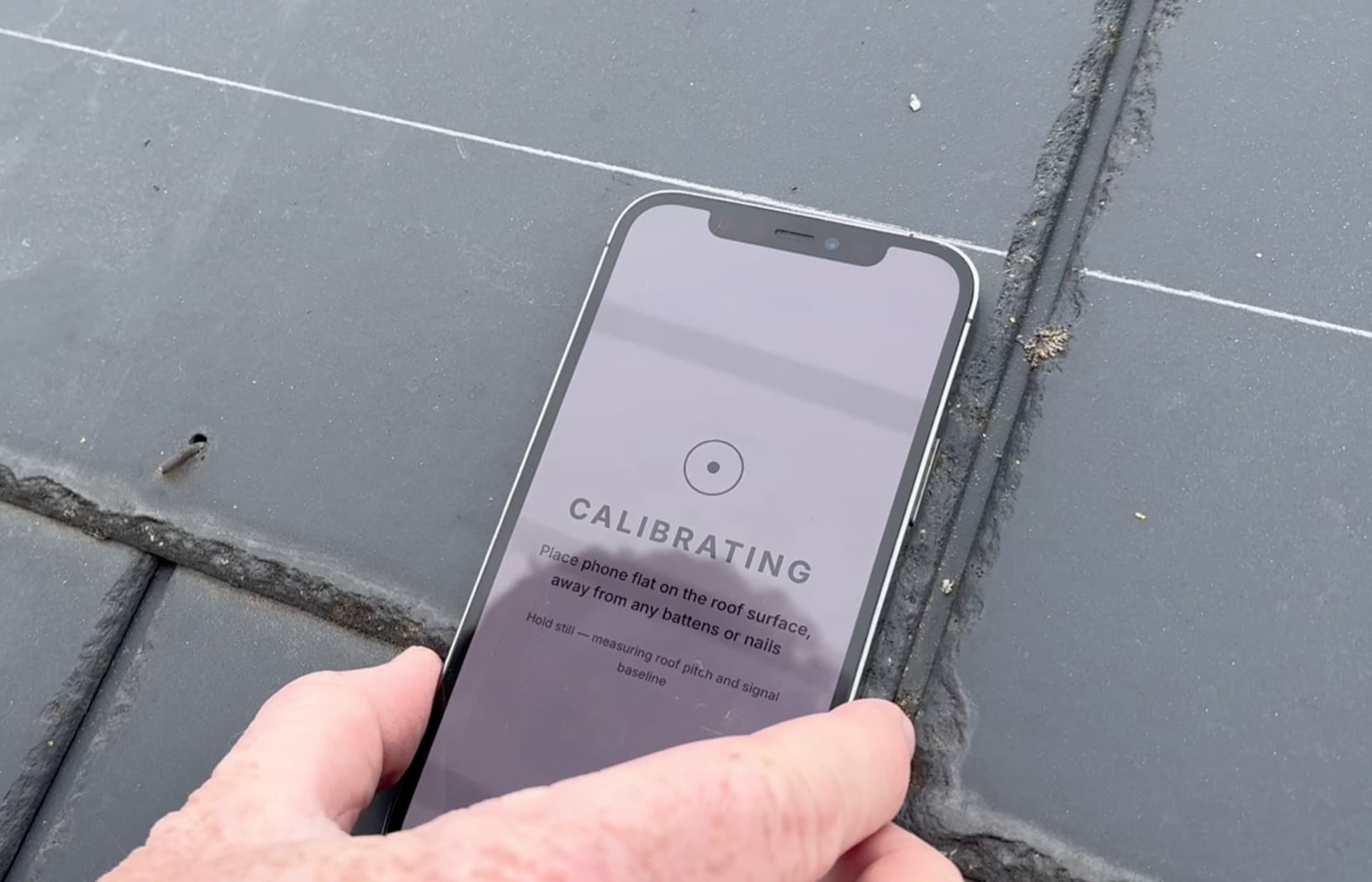
Installers often try a wall stud finder on a roof and walk away frustrated. It’s not a training issue — it’s physics. Roofs are not drywall.
Barrier one: density of the covering
Slate, clay, and concrete absorb or reflect the sensing energy before it reaches the timber. Capacitance and density-based stud finders are tuned for plasterboard and studs a few centimetres behind a flat wall — not dense mineral coverings outdoors.
Barrier two: the air gap
Even more important is the air gap between the underside of the covering and the rafter (often via battens). Sensors read the gap rather than the timber. A shallow gap is enough to break wall-oriented detection.
Why “better” radar units can perform worse
Premium ground-penetrating style detectors can throw more reflections off the air gap, so readings get noisier. Spending more on a wall or floor scanner doesn’t automatically solve roof rafter location — it can amplify the wrong signals.
What actually works
Rafter Finder looks for the magnetic signature of rafter and batten nails through the covering, and ignores most tile and slate clouts. On thin coverings like slate the free app is enough. Magnets can help on some thicker free jobs. Pro is for every roof covering, with deeper, higher-resolution hardware.
Stop fighting stud finders. Download Rafter Finder free.